In a statement issued today, Indian Health Service Director Yvette Roubideaux praised the recent passage of the health insurance reform legislation, which included the reauthorization of the Indian Health Care Improvement Act.
“This law will improve the quality of health care and make it more accessible and affordable for the American people, including American Indians and Alaska Natives,” she said.
Her statement highlighted several provisions that will benefit Native American people specifically:
• Health insurance reform creates a state-based health exchange through which individuals and small businesses can purchase health insurance coverage. This will create more affordable insurance options and allow comparison of plans.
• American Indians and Alaska Natives who purchase health insurance through the exchange do not have to pay co-pays or other cost-sharing if their income is under 300 percent of the federal poverty level.
• The value of health services/benefits from IHS-funded health programs or Tribes will be excluded from an individual’s gross income so it cannot be taxed.
• Health insurance reform also expands Medicaid coverage to individuals with incomes up to 133% of poverty level.
• For individuals who have Medicare Part D coverage (medication costs), I/T/U spending will count toward the coverage gap (donut hole).

Showing posts with label IHS. Show all posts
Showing posts with label IHS. Show all posts
Wednesday, April 14, 2010


Thursday, March 25, 2010
Facebook Group Provides a Forum for Disgruntled IHS Patients
 Angel White Eyes never imagined her six-hour wait at an Indian Health Service facility would be of interest to so many. But her Facebook group about the experience – “I just spent 6 hours at IHS just for them to give me Tylenol” – has drawn more than 1,900 members since she started it in January.
The group’s name is a summary of what happened on her trip to the clinic. To date 1,946 people from throughout Indian Country have signed onto the group, most of them to share their own frustrations with the IHS.
To read the full story, click here.
Thursday, February 4, 2010
Campaign Urges Native Parents to Protect Preteens with Vaccines
The Centers for Disease Control and Prevention and the Indian Health Service have jointly launched a campaign to educate American Indian and Alaska Native parents and other caregivers about the importance of a preteen medical check-ups and vaccines.
One goal of this campaign is to encourage parents to take their preteens in for an 11- or 12-year-old check-up, during which the doctor takes a complete medical history, screens for diseases like diabetes, discusses teen issues (such as puberty) and ensures that immunizations are up to date.
Three vaccines are specifically recommended for the preteens: MCV4 (meningitis); Tdap (tetanus, diphtheria, and pertussis or “whooping cough” booster); and for girls, the human papillomavirus (HPV) vaccine (protects against cervical cancer). Annual seasonal flu shots and vaccination against H1N1 are also recommended for preteens.
Posters and flyers educating parents about the preteen check-up and preteen vaccines were developed and can be ordered or downloaded from the campaign Web site: www.cdc.gov/vaccines/preteen/aian.
Other campaign activities include outreach to Native media, partnerships with American Indian and Alaska Native organizations that reach parents and healthcare providers and a community-based education project in New Mexico.
One goal of this campaign is to encourage parents to take their preteens in for an 11- or 12-year-old check-up, during which the doctor takes a complete medical history, screens for diseases like diabetes, discusses teen issues (such as puberty) and ensures that immunizations are up to date.
Three vaccines are specifically recommended for the preteens: MCV4 (meningitis); Tdap (tetanus, diphtheria, and pertussis or “whooping cough” booster); and for girls, the human papillomavirus (HPV) vaccine (protects against cervical cancer). Annual seasonal flu shots and vaccination against H1N1 are also recommended for preteens.
Posters and flyers educating parents about the preteen check-up and preteen vaccines were developed and can be ordered or downloaded from the campaign Web site: www.cdc.gov/vaccines/preteen/aian.
Other campaign activities include outreach to Native media, partnerships with American Indian and Alaska Native organizations that reach parents and healthcare providers and a community-based education project in New Mexico.
Wednesday, February 3, 2010
Contract Support Funding to Rise by $64 Million
The FY 2011 budget requests of the Bureau of Indian Affairs and Indian Health Service have a combined increase of over $64 million for contract support costs. These funds are used to fund tribes' indirect costs associated with P.L. 93-638 contracts and compacts.
It is important for tribes to prepare their FY 2011 indirect cost proposals in a manner that insures full recovery of allowable overhead costs. For information or assistance in preparing these proposals, please contact Tom Wilkins at 800-992-4489, ext. 119 or tom.wilkins@falmouthinstitute.com
It is important for tribes to prepare their FY 2011 indirect cost proposals in a manner that insures full recovery of allowable overhead costs. For information or assistance in preparing these proposals, please contact Tom Wilkins at 800-992-4489, ext. 119 or tom.wilkins@falmouthinstitute.com
Wednesday, July 22, 2009
New IHS Director Dr. Yvette Roubideaux
 Yvette D. Roubideaux (Rosebud Sioux), M.D., M.P.H., was confirmed as the director of the Indian Health Service by the U.S. Senate in May. Since then, she has been very busy. Sure, she has been putting a lot of time into administering a $4.3 billion national health care delivery system, but she has also been fielding loads of inquiries from the media. Roubideaux is, after all, the first woman to head the IHS in its 54-year history.
AIR caught up with Roubideaux this summer. We posed some questions on why she was picked to lead the IHS, what she hopes to accomplish, about the big boost the agency got from the Recovery Act and could get in the federal government’s FY 2010 budget and health care reform. [Read more]
Thursday, May 14, 2009
Yvette Roubideaux Sworn in as IHS Director
The Indian Health Service has a new director. Dr. Yvette Roubideaux, M.D., M.P.H., a member of the Rosebud Sioux, was sworn in on May 12, less than a week after she was confirmed by the U.S. Senate.
As IHS director, Roubideaux will administer a $4 billion, nationwide program that provides health care to approximately 1.9 million American Indians and Alaska Natives.
Roubideaux previously worked for IHS as a clinical director and medical officer at the San Carlos Service Unit on the San Carlos Apache Indian reservation and as a medical officer at the Hu Hu Kam Memorial Indian Hospital on the Gila River Indian reservation.
She recently served as assistant professor of family and community medicine at the University of Arizona College of Medicine and has conducted extensive research on American Indian health issues.
You can find out more about Roubideaux in the IHS Director’s Corner on the IHS Web site.
As IHS director, Roubideaux will administer a $4 billion, nationwide program that provides health care to approximately 1.9 million American Indians and Alaska Natives.
Roubideaux previously worked for IHS as a clinical director and medical officer at the San Carlos Service Unit on the San Carlos Apache Indian reservation and as a medical officer at the Hu Hu Kam Memorial Indian Hospital on the Gila River Indian reservation.
She recently served as assistant professor of family and community medicine at the University of Arizona College of Medicine and has conducted extensive research on American Indian health issues.
You can find out more about Roubideaux in the IHS Director’s Corner on the IHS Web site.
Thursday, November 20, 2008
NCAI Statement on Daschle Nomination to HHS
National Congress of American Indians (NCAI) President Joe A. Garcia released the following statement in response to news reports that President-Elect Barack Obama intends to select former Senator Tom Daschle as Secretary of Health and Human Services.
"Given the severity of the health care crisis in Indian Country we are very encouraged to hear that President-Elect Barack Obama is likely to nominate someone like Sen. Tom Daschle as Secretary of Health and Human Services, who has a strong background on tribal issues and understands the realities of the Indian health care system. His past experience and profound expertise on Indian issues will be a tremendous benefit to Indian Country. Sen. Daschle was a strong advocate for Native Americans as the Senate Majority Leader and has always advocated strongly for Native people as a representative from
Thursday, November 13, 2008
Baucus Plan Calls for Increased Funding for IHS
Senate Finance Committee Chairman Max Baucus will announce his blueprint for health reform at noon today. Baucus describes the plan as his vision for both policy and the process in the upcoming health care reform debate. Noteworthy for Indian Country, Baucus acknowledges that federal spending on health care for Native Americans is far short of what is needed. His plan would increase funding for IHS and encourage Native Americans to enroll in other programs, such as Medicare, Medicaid and CHIP for those who are eligible to defray the costs borne by the IHS directly. Read the entire plan here.
Thursday, October 2, 2008
United Keetoowah Sues Federal Government Over Hospital
As of Oct. 1, the W.W. Hastings Indian Hospital, a 58-bed hospital in Tahlequah, Okla., is being operated by the Cherokee Nation, but the United Keetoowah Band of Cherokee Indians contends that the Indian Health Service violated federal law when it turned it over to the tribe, 5 News reported yesterday. The lawsuit requests an injunction to stop the Cherokee from having operational control of the facility.
Opened in 1984, the facility provides medical services, including specialized services, to more than 100,000 Native Americans in a 4,300-square-mile area. The Cherokee Nation would like to expand it to accommodate increased demand.
5 News reported that Cherokee Nation Principal Chief Chad Smith said the lawsuit is an attempt by the Keetoowah to claim jurisdiction within Cherokee boundaries.
Opened in 1984, the facility provides medical services, including specialized services, to more than 100,000 Native Americans in a 4,300-square-mile area. The Cherokee Nation would like to expand it to accommodate increased demand.
5 News reported that Cherokee Nation Principal Chief Chad Smith said the lawsuit is an attempt by the Keetoowah to claim jurisdiction within Cherokee boundaries.
Tuesday, September 30, 2008
Green Bay Urban Indian Clinic Loses IHS Contract
The Indian Health Service will not be renewing its annual contract with the Native American Services Center in Green Bay, Wis., which means the center will have to shut down its urban Native American health program, according to an article published this morning by the Green Bay Press Gazette.
Only a year in operation, the contract provided the center’s clinic with a one-year grant of $276,000 with the option to renew. Mid-month in September, the center received a letter from the IHS Bemidji Area office saying, "The agency has simply exercised its option not to renew the contract," the Press Gazette reported.
About 3,555 Native Americans who live off reservations are eligible for health services that the center provides, including substance abuse counseling and diabetes testing. The center serves between 166 and 523 people per month, according to the Press Gazette.
Only a year in operation, the contract provided the center’s clinic with a one-year grant of $276,000 with the option to renew. Mid-month in September, the center received a letter from the IHS Bemidji Area office saying, "The agency has simply exercised its option not to renew the contract," the Press Gazette reported.
About 3,555 Native Americans who live off reservations are eligible for health services that the center provides, including substance abuse counseling and diabetes testing. The center serves between 166 and 523 people per month, according to the Press Gazette.
Thursday, September 4, 2008
Excessive Alcohol Consumption is Leading Cause of Preventable Death in Indian Country
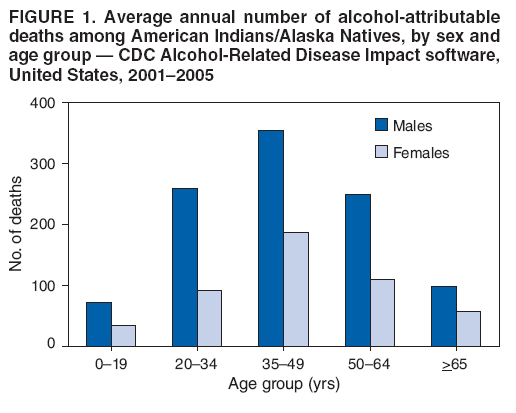 Excessive alcohol consumption is the leading cause of preventable deaths among American Indians and Alaska Natives, according to a report issued by the Centers for Disease Control and the Indian Health Service. The report, the first of its kind, says that alcohol-related deaths account for 11.7 percent of all deaths among American Indians and Alaska Natives – nearly twice that of the general population.
 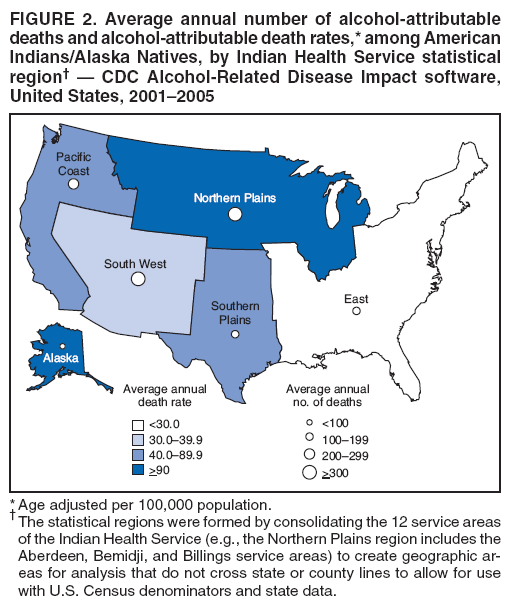 “These findings underscore the importance of implementing effective population-based interventions to prevent excessive alcohol consumption and to reduce alcohol-attributable morbidity and mortality among AI/ANs,” researchers concluded.
Thursday, August 28, 2008
CBCA Rules on Indirect Cost Disputes
The Civilian Board of Contract Appeals in July ruled on claims submitted by tribal governments or Alaska Native villages with awards under the Indian Self Determination Act. A number of these claims were dismissed because the statute of limitations had run out, but in the claims that were not dismissed, the main issue focused on t he payment of contract support from the Indian Health Service. The board ruled that the IHS must demonstrate that it has actually paid the full amount of ISD contract support dollars allocated to it by Congress for the years in questions. If the IHS cannot document that it has paid the full allocation, then the tribes will have a claim against the agency.
Wednesday, June 25, 2008
IHS may stop funding to tribes charging co-pays
Several tribes could be in danger of losing IHS funding within the next few months if they do not cease charging eligible beneficiaries for any portion of health services or medicine they receive at IHS-funded facilities, according to Indian Country Today.
The paper reports that federal agency has been holding consultations with tribes nationwide since April to try to get a handle on the number of tribes conducting the practice.
Ronald B. Demaray, acting director of the agency's Office of Tribal Programs said the agency is considering terminating its relationship with tribes charging co-pays.
The paper reports that federal agency has been holding consultations with tribes nationwide since April to try to get a handle on the number of tribes conducting the practice.
Ronald B. Demaray, acting director of the agency's Office of Tribal Programs said the agency is considering terminating its relationship with tribes charging co-pays.
Subscribe to:
Posts (Atom)